Prevent Contaminated Fuel From Reaching Customers
For fuel retailers, protecting the quality of product at the tank is critical.
Water in a fuel tank is never something to ignore. But when you’re storing ethanol-blended gasoline, enough water contamination will create an even bigger problem.
Under the right conditions, enough water will cause the ethanol and gasoline components to separate from one another. The result is phase separation—a distinct separation of the fuel into layers rather than a properly blended product.
Once phase separation occurs, the fuel will no longer be suitable for normal use, and will require specialized removal and remediation. The State will not allow phased fuel to be sold due to the octane levels being incorrect.
Don’t wait until the state shuts you down or your pumps are damaged. Phase Separation does not fix itself, and will get worse. Many companies try to fix this problem by adding a higher octane, but this does not work until all of the phase is removed and chemically stable. Trying to fix this problem on your own always costs you more money. Don’t worry, Tank Rx has the prescription and will have you up and running in no time.
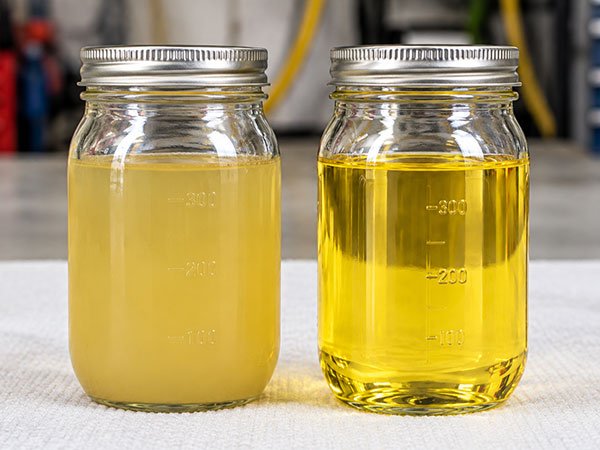
Fuel samples showing before and after phase separation. We get the phase out and you keep the gas.
Most gasoline sold in the United States contains ethanol, with E10 being a common blend. Ethanol has an affinity for water, so water contamination can become a serious concern in ethanol-blended fuel.
Water can enter a fuel system through a variety of pathways, including condensation, rainwater intrusion, damaged or compromised fill components, fuel tank vents, or poor seals. Water can also be introduced during delivery or handling, among other sources of water contamination
When enough water accumulates, the fuel will separate into a gasoline-rich layer and a water/ethanol-rich layer.
You may have a phase separation problem if:
The only way to properly understand what’s happening is to evaluate the fuel. Tank Rx can diagnose phase separation and prescribe the cure!
Remediation can be useful for any operation that stores fuel for extended periods or depends on stored fuel when it matters most.
Tank Rx can help businesses that store ethanol-blended gasoline, including:
The longer contaminated fuel remains in a storage system, the greater the opportunity for the problem to affect downstream equipment.
Separated fuel can result in poor engine performance, fuel-system problems, customer complaints, contaminated product and potentially significant fuel loss.
For a busy fueling facility, a small amount of water can become a very expensive problem.
Don’t wait until the fuel reaches the pump.
Don’t guess. Start with a fuel sampling.
Tank Rx can evaluate the condition of your fuel and help determine whether you’re dealing with water contamination, phase separation or another fuel-quality problem.
We’ll diagnose the problem and prescribe the solution.